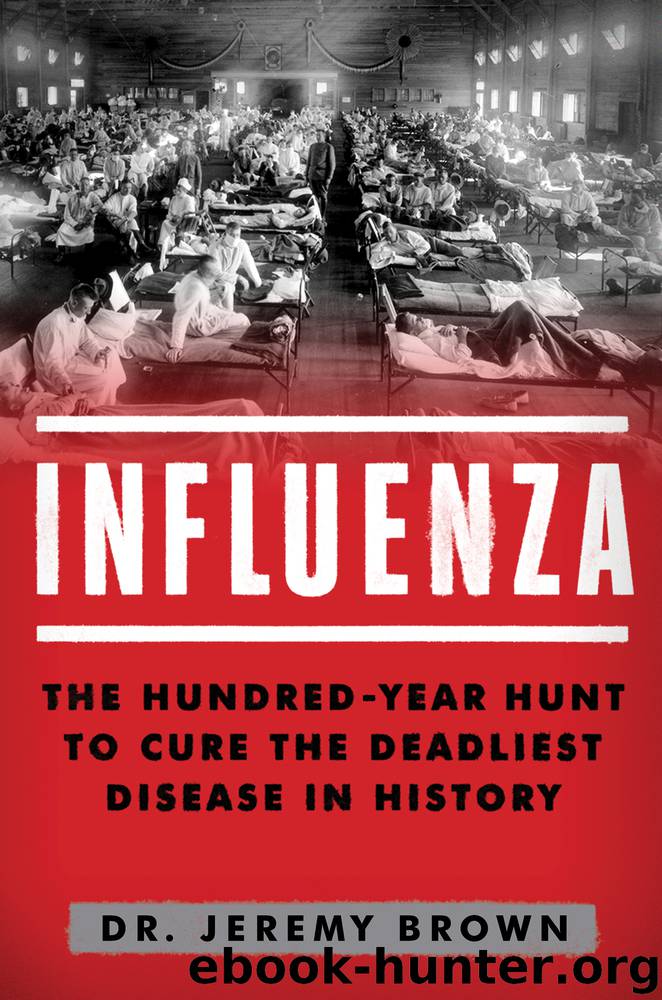
Influenza by Jeremy Brown
Author:Jeremy Brown
Language: eng
Format: epub
Publisher: Touchstone
9
* * *
THE HUNT FOR A FLU VACCINE
Vaccination, the process of infecting a healthy person with a microbe to prevent disease, dates back at least a thousand years. Some kind of inoculation was used by the Chinese as early as the tenth century, and in eighteenth-century Bengal (now India and Bangladesh), members of the Brahman caste used vaccination in their religious rituals. Every spring, priests traveled the Indian countryside to cut and scrape people across an area of skin the size of a silver coin, drawing blood and then applying a cotton ball containing smallpox and two or three drops of water from the Ganges River.
Vaccines are one of the great success stories of modern medicine. Because of them we are no longer vulnerable to smallpox or polio or measles. The flu vaccine, however, is a different story. Its effectiveness varies from patient to patient, from population to population, and from year to year. It needs to be updated each season, and even in a good year is usually no more than 50 percent effective. We may rely on it to avoid catching the flu, but its story demonstrates how far we still are from a reliable vaccine.
The start of vaccination as we think of it today is generally credited to the work of Edward Jenner, a British physician born in 1749. Jenner was a keen observer with a deep interest in the natural world, and found time for both serious study and artistic play. He investigated everything from hydrogen balloons to the life cycle of the cuckoo, wrote poetry and played the violin, but smallpox—or rather, the eradication of it—is his legacy. Because of Jenner, this virus is not on our list of worries today.
Smallpox was a vicious disease that killed more than 75 percent of those who contracted it. In the 1700s, there was one demographic, however, that seemed to be immune: milkmaids. It had been observed that in the course of their job milking cows, women came into contact with the milder bovine version of the smallpox virus, this one called cowpox. These women then became immune to the deadlier human smallpox virus. There was something in the cowpox that protected against smallpox, and in 1796 Edward Jenner famously took material from the fresh pustules on a milkmaid’s hand and inserted it under the skin of a young boy named James Phipps. After a brief and mild illness, Phipps recovered completely. Jenner then infected him with scrapings from a smallpox lesion, again and again, but the boy never got sick. Jenner named this process vaccination after vaccinae, the Latin word for cowpox. His technique quickly spread through nineteenth-century England and beyond, saving countless people, inspiring modifications to the technique, and changing the course of history.
Jenner’s smallpox vaccine was improved and modified over the next several decades, and was soon joined by others. Louis Pasteur developed several vaccines for animal diseases like chicken cholera and anthrax, but of these he is best remembered for his rabies vaccine. Rabies was a common and uniformly fatal disease in the nineteenth century.
Download
This site does not store any files on its server. We only index and link to content provided by other sites. Please contact the content providers to delete copyright contents if any and email us, we'll remove relevant links or contents immediately.
| Africa | Americas |
| Arctic & Antarctica | Asia |
| Australia & Oceania | Europe |
| Middle East | Russia |
| United States | World |
| Ancient Civilizations | Military |
| Historical Study & Educational Resources |
The Radium Girls by Kate Moore(12036)
100 Deadly Skills by Clint Emerson(4932)
Rise and Kill First by Ronen Bergman(4797)
The Templars by Dan Jones(4695)
The Doomsday Machine by Daniel Ellsberg(4493)
The Rape of Nanking by Iris Chang(4224)
Killing England by Bill O'Reilly(4008)
Stalin by Stephen Kotkin(3973)
Hitler in Los Angeles by Steven J. Ross(3949)
12 Strong by Doug Stanton(3555)
Hitler's Monsters by Eric Kurlander(3352)
Blood and Sand by Alex Von Tunzelmann(3207)
The Code Book by Simon Singh(3197)
Darkest Hour by Anthony McCarten(3137)
The Art of War Visualized by Jessica Hagy(3014)
Hitler's Flying Saucers: A Guide to German Flying Discs of the Second World War by Stevens Henry(2759)
Babylon's Ark by Lawrence Anthony(2686)
The Second World Wars by Victor Davis Hanson(2529)
Tobruk by Peter Fitzsimons(2521)
